|
Bratislava is one of the youngest capitals in Europe and few
people know that during the time it was called Pressburg or Pozsony
it was one of the most important cities in the Austro-Hungarian
Empire. It was a mixing pot of various nations and nationalities
who lived together in peace and harmony. There is a saying that
a true 'Pressburgian' speaks four languages: Slovak, German,
Hungarian and Mishmash. Even as recently as the 1980s you might
hear how older Pressburgians in the street would say two words
in German, two in Hungarian and two in Slovak all in the space
of one sentence. That is what we mean by "mishmash".
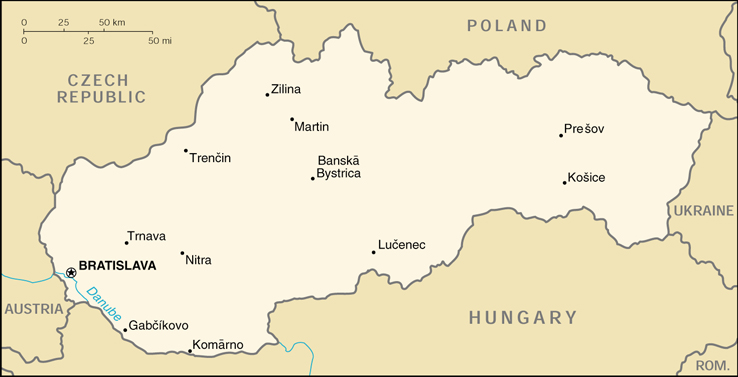
Bratislava's location on the banks of the River Danube and
at the crossroads of ancient trading routes right at the heart
of Europe predestined it to become a meeting point of various
cultures. It was the home of the Celts, the Romans, and the Slavs
... The reign of Maria Theresa is regarded as a golden era in
the city's history. She was crowned Queen of Hungary in St. Martin's
cathedral in Pressburg, just like the 10 other kings and 8 royal
partners over the course of 300 years when Pressburg was in fact
the capital of the Kingdom of Hungary.
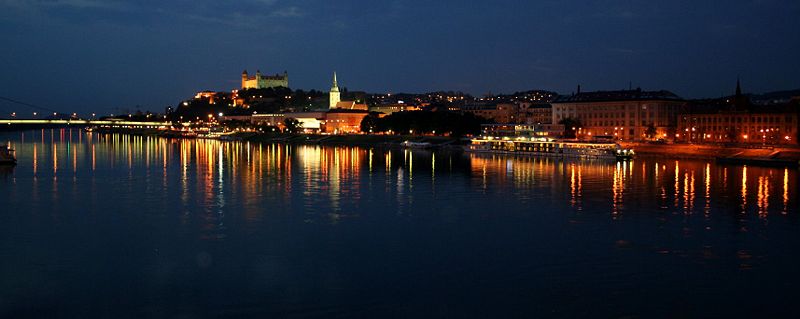
The rich mix of cultures and nations not only left its mark
in the language spoken here, but also in the customs, cuisine
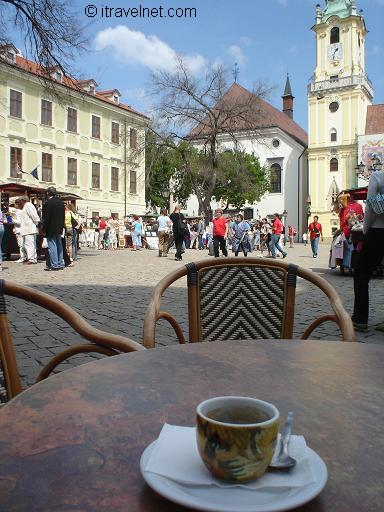
and lifestyle. Just like the Viennese, the people of Bratislava
also enjoy promenading through the streets of the city centre,
taking time out for a coffee in any of the many cafes. This part
of the city is referred to as the Korzo and combines elegance
with charm. Visitors say that the city has a relaxed Mediterranean
type atmosphere. Bratislava is a seaside city without the sea.
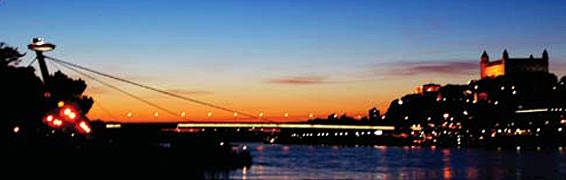
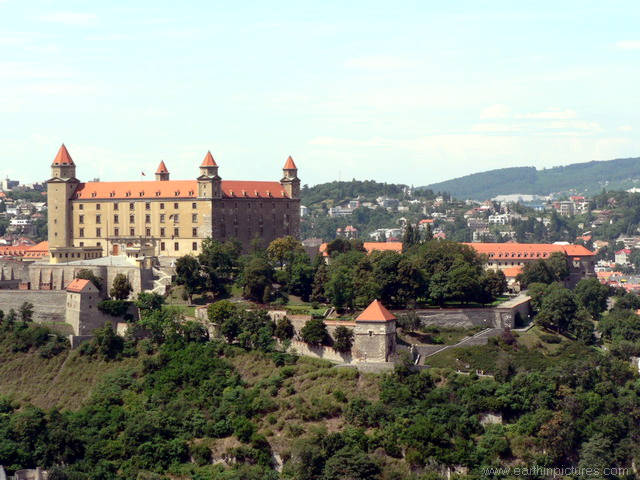 Bratislava Castle
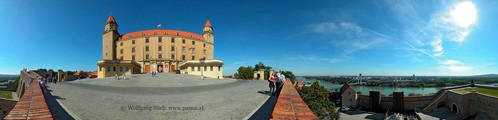
The castle building dates to 10th century and is situated on
a relatively separated hill of Carpathian mountains in Staré
mesto district (The Old Town). The hill used to be the boarder
of the Roman Empire. The building itself includes 4 towers (one
on each corner) and a courtyard where there is an 80m deep water
well. The Crown Tower in the south-west is the the biggest among
them, it dates back to the 13th century, and it housed the Hungarian
crown jewels for two centuries. Fragments of old Gothic and Renaissance
construction can still be spotted on the outside walls and inside
corridors.
To the east of the main entrance, a walled up entrance gate from
the 16th century can be seen. Behind the entrance, there is an
arcade corridor and then the big Baroque staircase leading to
the expositions of the Slovak National Museum (Slovenské
národné múzeum). In the left part of the
southern part of the building, there are 4 halls of the Treasure
Chamber (opened in 1988) which present a collection of the most
precious archaeological findings and other objects found in Slovakia.
Among the artifacts, visitors can see a prehistoric statue called
the Venus of Moravany. The 3rd floor offers the exposition named
History of Slovakia.
The 1st floor in the southern part of the building houses the
rooms of Slovak parliament - the National Council of the Slovak
Republic - including parts of furniture from the 16th century.
The Council has 150 seats. The main parliament building is situated
next to the Bratislava Castle on the castle hill. In the northern
part of the building- the former Baroque chapel, visitors will
find the Music Hall in which concerts are held. The courtyard
includes the entrance to the Knights Hall.
The last large reconstruction in Baroque style took place under
the reign of Maria Theresia (1740-1780). In 1811, the castle
burnt down and only ruins were left. It was reconstructed in
1956-68. Bratislava Castle is an important landmark Of the Slovak
capital and a National Cultural Monument. |
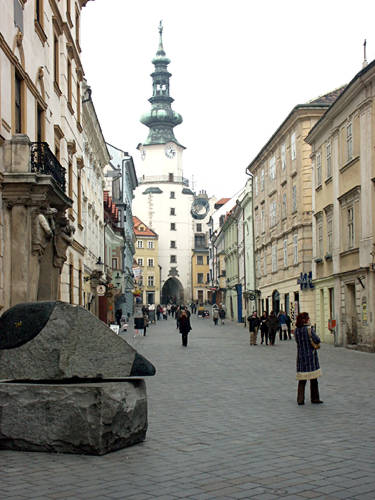
Nowadays Bratislava is experiencing a boom once more. Buildings
are popping up, deals being made, people studying, and everything
is on the move. Experts regard it as one of the most dynamically
developing and most prospective regions in Europe. It welcomes
tourists, business people, and investors, who are attracted to
this blooming city and its lively atmosphere. There are many
cities in Europe that can boast their own special unique charm,
and Bratislava is definitely one of them.
Bratislava has accommodation for everyone, whatever
the budget. More than 70 accommodation facilities provide services
of various categories and standards. The more costly ones are
in the city centre, many of which are right in the pedestrian
zone. More economical guesthouses and hostels can still be found
in the centre, however. Students, young people, and others, will
definitely appreciate the wide array of smaller guesthouses and
youth hostels in the city. During the summer many of the student
dormitories also offer accommodation in Bratislava. If you really
want to relax, you can use any of the hotels and guesthouses
on the outskirts of the city: the centre is never far away, and
you have the possibility of going horse-riding, playing tennis,
or just taking a forest walk. The tourist boom in Bratislava
has also reflected in the occupancy level of hotels, so we recommend
you book well in advance.
|
